Behind every piece, there is a gesture. And behind every gesture, a long time: that of learning, of error, of precision regained. A workshop is not a place where things are made quickly. It is a place where time is taken to do things well, and where the sound of the grinder eventually begins to resemble music.
You enter it as you enter a language you do not yet speak. There is the smell of heated metal, the fine dust of wood suspended in the light, the tools laid out in their places, as if waiting. Nothing there is spectacular, and yet everything matters.
The time of the hand
The hand does not learn like the mind. It does not retain a rule; it retains a sensation: the resistance of sheet metal when bent, the change in vibration when a weld is just right, the smoothness of a freshly sanded edge. This kind of knowledge cannot be fully written down. It is passed on by watching, by starting over, by making mistakes sometimes.
There is a form of humility in this work. The material always has the final word. It can be guided, rarely forced. Steel has its tensions, wood its fibers and its moods. The right gesture is not the one that imposes a shape, but the one that accompanies it until it holds on its own.
The crafts, a celebration of gesture
Every spring, the European Days of Crafts open workshops to the public throughout France and Europe. They are coordinated by the National Institute of Crafts, as stated by the Ministry of Culture, now renamed the Institute for French Know-How, according to the 2025 edition press release. The 20th edition was held from April 7 to 12, 2026, under the theme "Hearts at Work," according to Festival en France.
These days remind us of one simple thing: behind the objects we love, there are people, workbenches, and hours. Opening a workshop means revealing what usually remains invisible: the process rather than the result.
The label of rarity
The State also distinguishes companies with rare and exceptional know-how through the Living Heritage Company label, created in 2005 and awarded for five years, reminds the Prefecture of Île-de-France. A way of saying that luxury in France is first and foremost a matter of transmission: it is not bought, but received, perfected, and passed on.
Ultimately, rarity is not a question of price. It is a question of time given to a gesture, to a material, to a person who is learning.
Steel and wood, a school of patience
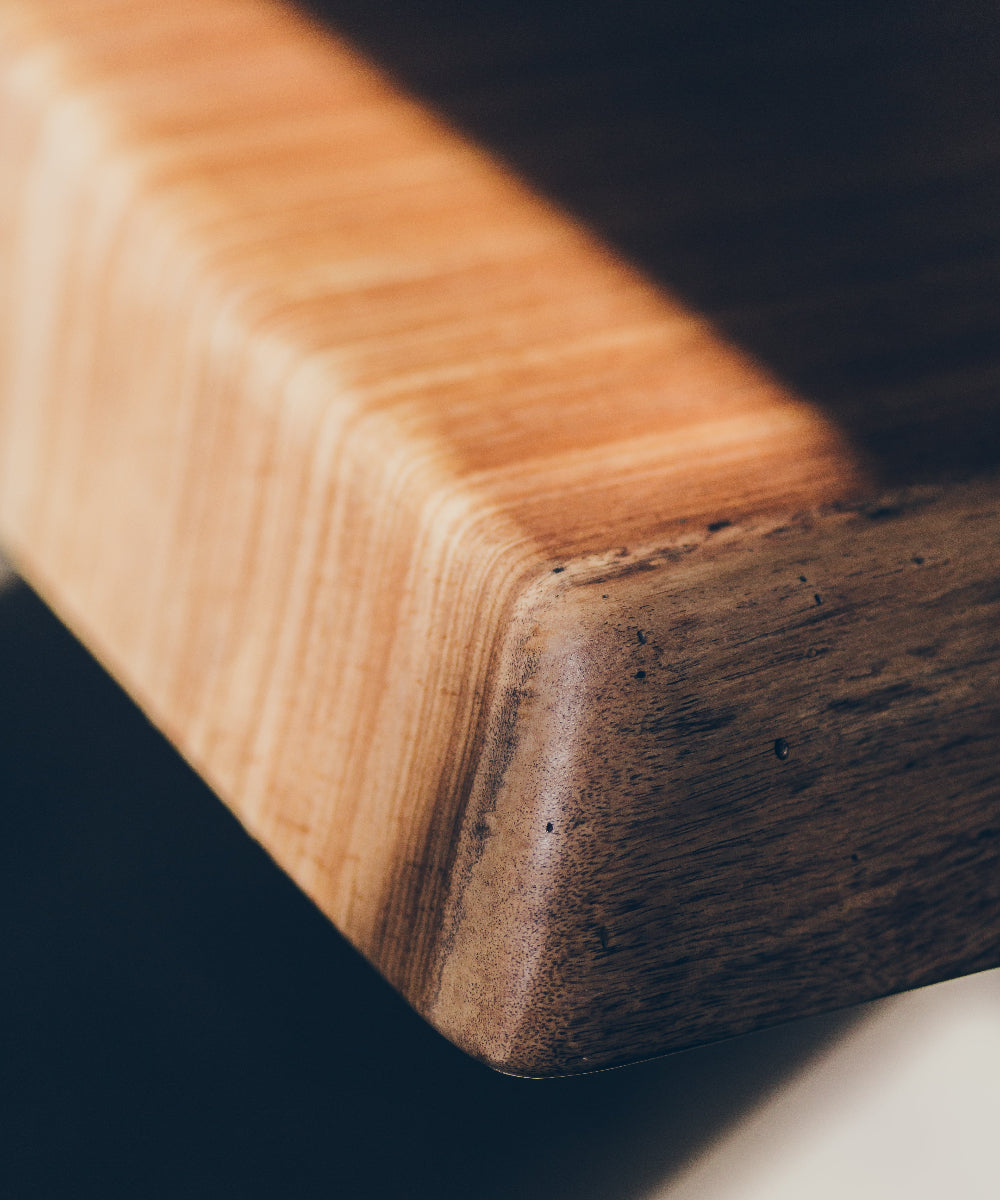
At Blunt France, steel is cut, bent, assembled, and finished. Solid wood is selected, sanded, and oiled. Each step has its own slowness, and none are skipped. A line of steel only becomes light after being worked for a long time. A wooden surface only reveals its grain after patient, increasingly fine passes.
Since 2006, our workshops in Biarritz have been handcrafting unique pieces. It is these details—a softened edge, a revealed grain, a perfect matte finish—that make a table a table worth keeping. You do not always notice them at first glance. You discover them over the years, with your fingertips.
What the hand leaves behind
Each piece is signed and dated the year of its creation. This is not a vanity: it is a way of saying that an object has an origin, a moment, and hands. The signature does not celebrate a name; it acknowledges work. And the date reminds us that the piece begins a story here that will continue elsewhere, with those who will experience it, and then with those to whom it will be passed on.
Touch before choosing
We believe in the power of material and its individuality. Hence the sample kit: to feel the steel and wood in your hand before choosing, as you would in the workshop. You will find the same standard in our article on Cenitz, in our heritage, or by opening the door to the design studio.
The raw timeless elegance.