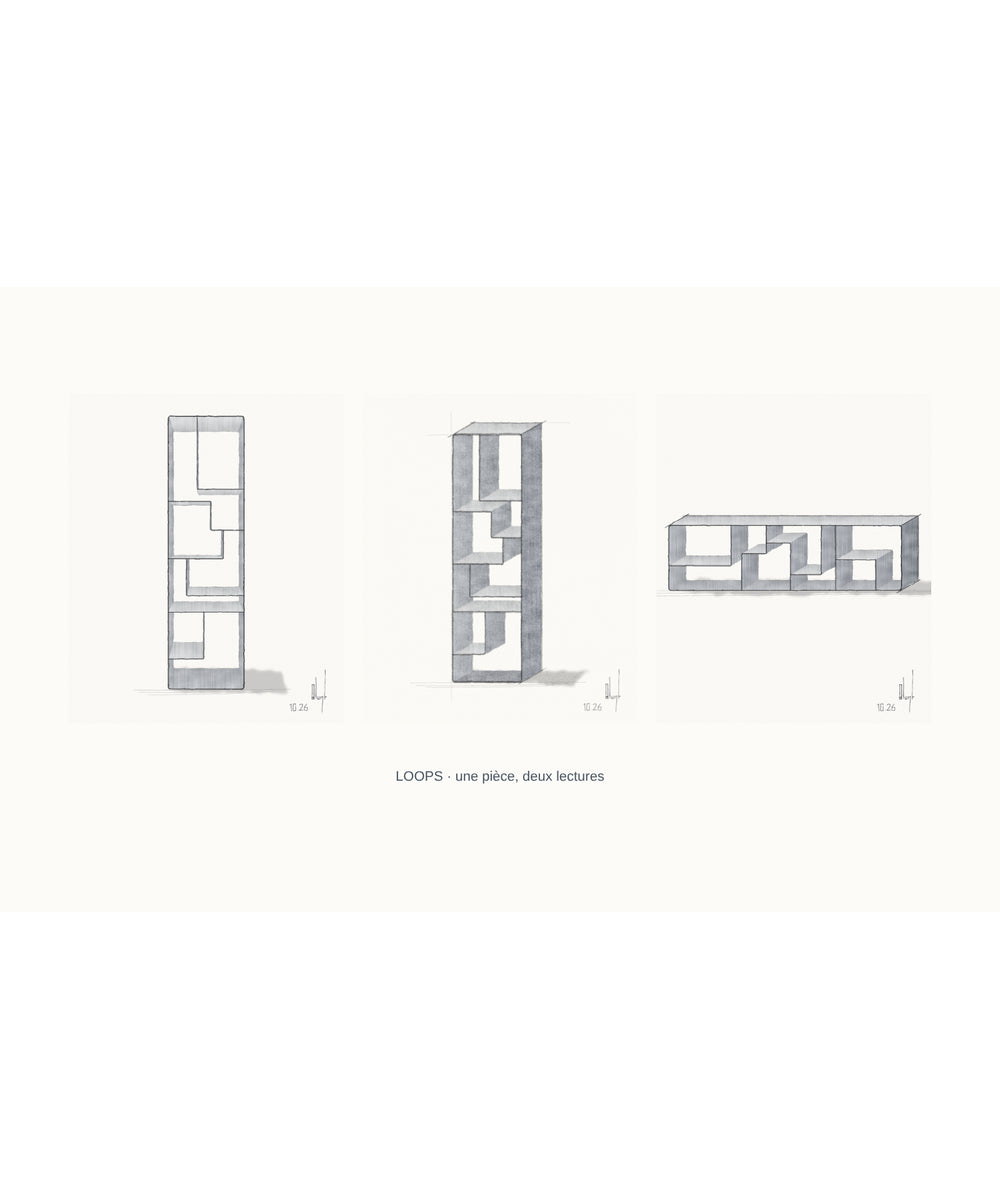
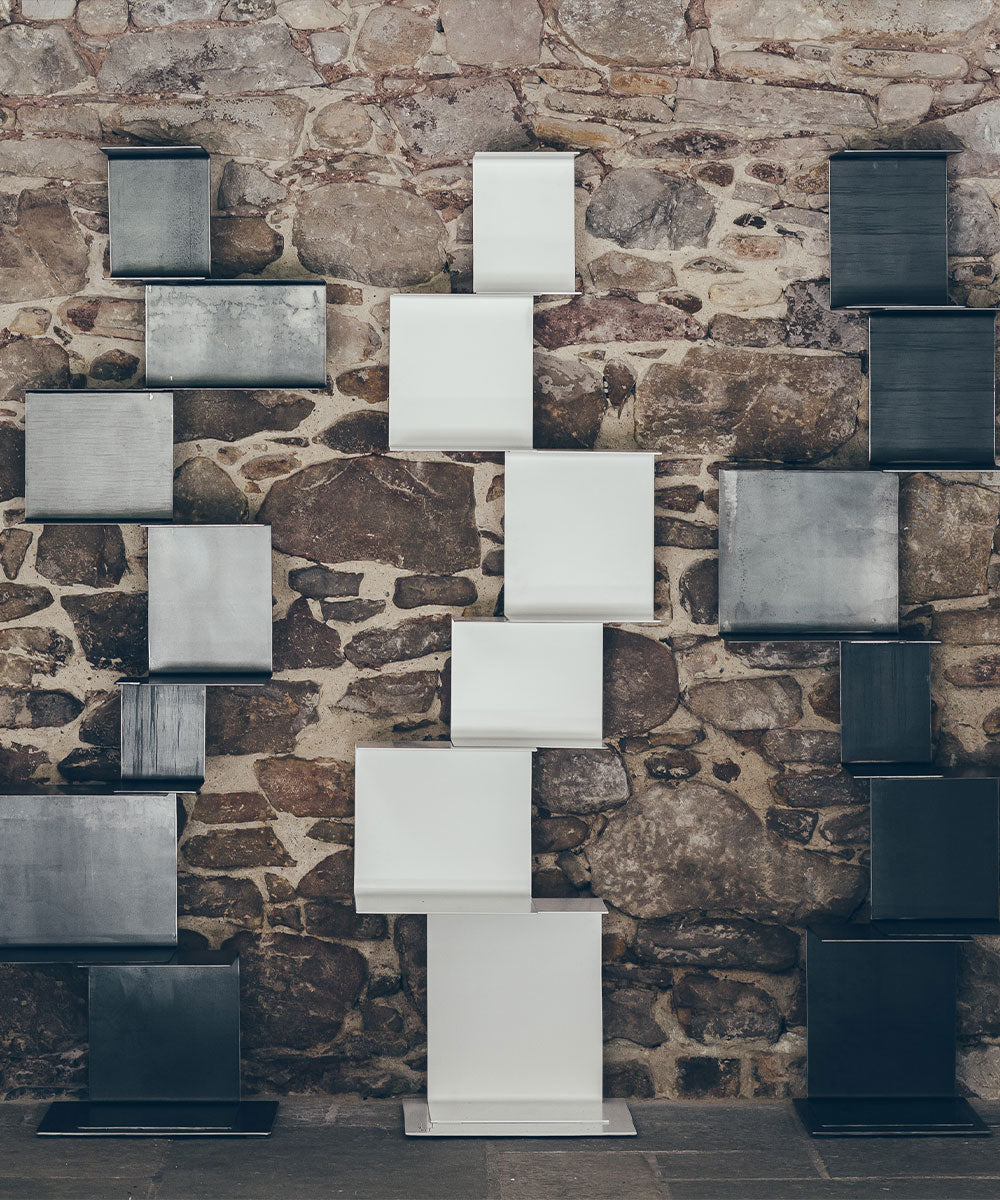
What if disorder were the most sophisticated form of order? Look at a forest, a flock of starlings, a dry stone wall: nothing is aligned, yet everything is just right. With Twist, irregular cubes are stacked as if at random, forming a bookcase unlike any other.
This randomness is not really random at all. It requires an eye, a hand, and a long pause before each volume finds its place. What appears spontaneous is often what has been looked at the most.
Cubes, no rules
The Twist collection arranges cubes of various sizes into a deliberately unstructured line. The Twist bookcase is available in heights of 150 or 190 centimeters, in Dark, Used, or Color steel. The Double Twist and the Twist Tree extend the design with greater scale.
From one version to another, the principle remains the same: no cube is exactly like its neighbor. The eye never grows bored; it moves around, returns, and discovers an angle it had not seen before. The piece reveals itself slowly, like a musical score.
The cube, an artist's obsession
The American artist Sol LeWitt made the cube a language. From 1965 onward, he built modular structures around the open cube and combined them in series according to a pre-established plan, as the Allen Memorial Art Museum recalls. His structures were then realized on a large scale in aluminum or steel; and in the mid-1980s, he turned his attention to irregular forms, according to the Public Art Fund. In LeWitt's work, the cube obeys a system; in Twist, it escapes it with elegance.
There is a simple lesson here: an elementary form can hold an infinite number of combinations. The cube is the humblest of geometries, and perhaps that is why it lends itself so well to freedom.
Steel, to hold the imbalance
For a stack to appear light, it requires a material that will not give way. Steel gives Twist this quiet confidence: the cubes seem to rest on one another, almost suspended, while the whole holds firmly. This is the paradox of the piece: an appearance of fragility supported by a solid structure.
In the Dark or Used finishes, the surface retains the memory of the work—its nuances, its ever-changing reflections. In Color, it becomes more graphic. Each finish tells the same geometry with a different voice.
The hand that composes, the emotion that guides
Finding the perfect imbalance of Twist is a matter of manual intelligence: each cube is bent, assembled, and adjusted until the whole holds with apparent ease. But the composition also responds to another intelligence, an emotional one: the one that seeks the little surprise, the smile, the moment when the eye stops and you feel at ease in front of a wall. A bookcase is not just storage; it is an interior landscape.
A bookcase to be looked at as much as filled
Books, objects, silences: each cube welcomes whatever you choose to place on it, and emptiness is part of the composition. A sculptural yet useful steel designer bookcase that becomes the focal point of a living room or office.
It can be filled to overflowing or left almost bare. A single open book, a stone gathered from the beach, a piece of ceramics: Twist does not judge; it frames. It changes with those who inhabit it, through readings and seasons.
To give, to inhabit
The Twist bookcase is also one of our ideas for a gift. A way of saying that elegance is meant to be shared, and that a piece of furniture can be a way of looking at the world differently. Discover the same lightness in Cenitz.
The raw timeless elegance.